


Did you know Anantasana is the easiest to practice among the relaxing and balancing categories? Yes! Anantasana helps your body experience a deep sense of relaxation with regular practice. Also called the ‘pose of Lord Vishnu’s infinite serpent,’ Anantasana holds significant importance in Hindu mythology. Named after Ananta, the preserver of the universe, the thousand-headed serpent on which Lord Vishnu reclines. By practicing Anantasana, you can find the connection to the infinite potential within while aiming to cultivate a sense of balance and flexibility mirroring the divine qualities of Lord Vishnu and the serpent Ananta.
Anantasana, also called Vishnu’s couch pose, has some alternative names in different yoga traditions, which are Side-reclining leg lift, Eternal one-legged pose, Sleeping Vishnu pose, Reclining Vishnu pose, Side Lying leg stretch, Supta Ardha Padmasana.


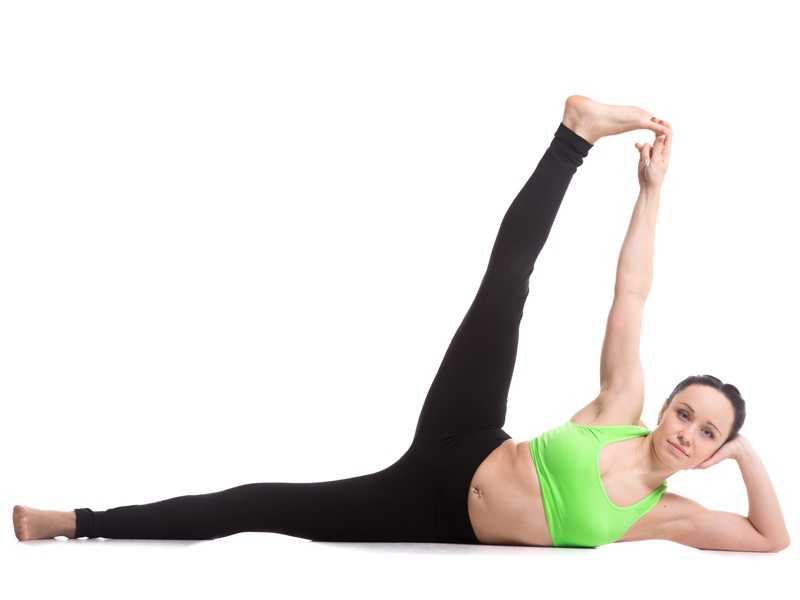
Image Source: shutterstock
This article will examine the benefits, variations, and how to perform Anantasana in detail. Read on!
How to do Anantasa or Sleeping Vishnu Pose:
Here is a simple and easy-to-do guide that will aid you in practicing Anantasana correctly to reap the benefits of this yoga pose.
Place a yoga mat on the floor and lie on your left side.
Now, keep your right foot over the left foot symmetrically.
Use your foot to balance your body while you press the left heel and spread your ankle.
Spread your left arm to make a straight line from your heels to your fingertips, parallel to the torso.
Move your left arm outside and place it on the mat as you stretch your armpit.
Rest the head’s left part in your palm while raising the torso and head.
Make sure your left hand’s upper part and forearm are in a vertical position.
Point the right leg upside while rotating it.
Now draw them towards the torso as you bend the knees.
Use the thumb and the first two fingers to hold the big toes on the right leg.
Adjust the sacrum against your pelvis to balance your raised leg by using it as a fulcrum while lifting your leg and breathing in.
Remain in this pose for about 30 seconds to a minute by pressing both heels, and it is the final yoga Anantasana pose.
You can practice this pose for a short period initially and then increase the time as you get comfortable.
Now balance your body by using your left foot and release your legs by unlocking the grip of your legs and arms.
Move your elbow to the torso’s left side and place the right hand on the side of the thigh.
Relax for a few seconds and repeat Anantasana yoga as long as you are comfortable.
See More: Dhanurasana Bow Pose
Preparatory Poses for Anantasana:
The preparatory poses for Anantasana that will make practicing this pose much more comfortable are:
Supta Padangusthasana (Reclining Big Toe Pose).
Utthita Trikonasana (Extended Triangle Pose).
Parighasana (Gate Pose).
Benefits of Anantasana:
Here is the list of benefits you reap by practicing the side reclining leg lift yoga pose:
You can strengthen and stretch the sides of your torso, the back of your leg, and your hamstrings with Anantasana practice.
Your spine and leg flexibility is also increased significantly.
Anantasna improves digestion by toning down the abdominal muscles.
This Asana also helps reduce weight in the thighs and hips while developing the pelvic region.
The circulation in the legs is improved significantly with the regular practice of Anantasana.
It is also beneficial in relieving your body’s stress and tension and relieving arthritis, colitis, hypertension, and sciatica.
The sleeping Vishnu pose might also cure urinary, bladder, uterus, prostate, and ovaries issues.
Precautions and Contraindications:
The side reclining lift pose or Anantasana is easy to practice and simple to learn. However, suppose you wish to avoid strain in muscles and prevent injury. In that case, following some of the following precautions is advised.
Consult a doctor before adding Anantasana pose into your daily routine, especially if you have spondylitis or cervical or slipped disc conditions.
Sleeping Vishnu pose might worsen conditions like scoliosis; therefore, avoid performing this pose if you have such backbone conditions.
Wait to perform Anantasana pose if you experience Sciatic pain or have any shoulder injury.
See More: Bhujangasana Cobra Pose
Variations of Anantasana:
If you are bored doing the Asana Similarly, you can try the following variations or modifications in Anantasana.
You can support your back using a bolster or a wedge as you recline.
Instead of reaching your toes, you can use a strap to wrap around the ankles and hold the strap. Adding the strap to this pose will make Asana’s toe-grabbing part’s side reclining leg lift much more effortless.
You can try a variation where you don’t have to raise your torso and rest the head inside your left arm if you want to make practicing this Asana easier.
Anantasana aids in balancing and relaxing your body and is considered one of the easy-to-do asanas. This Asana improves the body’s balance and flexibility that help you perform daily activities when you practice this Asana in the right way. Please review the information we have provided in this article and take guidance from a professional to be safe. Don’t forget to let us know if you found the article helpful!
See More: How To Do Padmasana
FAQ:
1. What are the essential tips for beginners to perform Anantasana?
Here are the simple things you need to keep in mind while performing Anantasana as a beginner to reap the most benefits:
Resting heads in their palms might cause pressure on the necks for beginners. Therefore, try to engage your torso to reduce the strain on your neck during the resting phase.
Beginners might find it challenging to stretch their legs during the initial days of practicing this Asana.
2. What is the scientific aspect of Anantasana?
Practicing Anantasana feels like you are lounging around and seems very easy to perform. However, to perform Anantasana peacefully while being comfortable, you will need more balance, flexibility, and strength. Anantasana also helps you find the knowledge, steadiness, and abyssal of intuitive rest while motivating you to look deep inside your mind.
3. Can anyone perform Anantasana?
Though most people can perform Anantasana, respecting your body’s limitations and awareness is necessary while approaching this pose. Using blankets or bolsters for support can be beneficial for beginners to modify the pose. However, people with injuries in the hips, shoulder, or knees or certain medical conditions need guidance from a professional before trying this pose.
Advertisement


Advertisement


Advertisement


